Carregando...

isaLsd
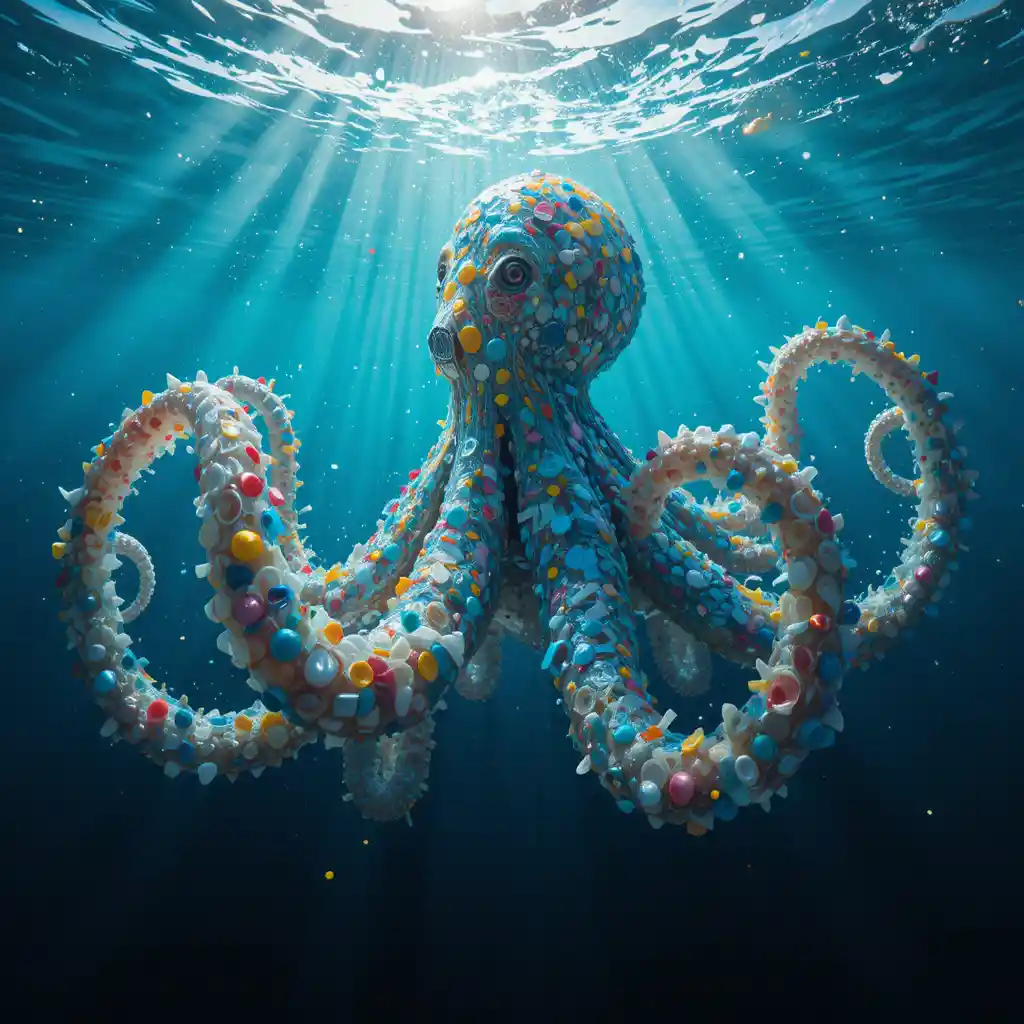
Um polvo feito de resíduos plásticos flutua sob águas oceânicas iluminadas pelo sol
Prompt
A cinematic deep-sea environmental artwork depicting a giant octopus formed entirely from discarded plastic waste, floating underwater in a vast, dark blue ocean.
The octopus is the dominant subject and fills much of the composition. Its head and eight long, curling tentacles are clearly recognizable as a real octopus, but every visible part of its body is constructed exclusively from plastic pollution.
The body is made from highly translucent, thin, crinkled and semi-transparent plastic film, allowing the viewer to clearly see an enormous quantity of plastic waste trapped within and forming the creature. Inside and throughout the translucent body are numerous discarded plastic objects: crushed transparent water bottles, blue bottle caps, white and red drinking straws, yellow and green plastic bags, colorful packaging fragments, pieces of plastic containers, bottle rings, small plastic fragments, tangled plastic netting and miscellaneous microplastic debris.
The transparency is extremely important: the plastic structure must remain visibly translucent so that the individual pieces of garbage can be clearly distinguished inside the octopus rather than appearing as an opaque mass.
The octopus has large expressive eyes made from dark plastic bottle caps, with realistic glossy reflections. Its tentacles curl naturally in different directions, creating many separate areas where plastic waste can be seen. The undersides of the tentacles contain numerous circular plastic bottle caps and fragments arranged in a way that subtly suggests suction cups while still looking unmistakably like discarded plastic.
Some tentacles are stretched toward the foreground while others curl backward into the water, creating a strong three-dimensional composition and maximizing the visible amount of plastic waste.
Above the octopus, the turquoise ocean surface ripples gently and sunlight penetrates the water, producing dramatic volumetric white-blue light rays. The light catches the transparent plastic edges, creating realistic refractions, reflections, caustic patterns and sparkling highlights.
The surrounding water gradually becomes darker and deeper blue toward the bottom of the image. Hundreds of tiny suspended particles, fragments of microplastic and small bubbles drift through the water, adding depth and realism.
The overall mood is somber, haunting and ca
Model
PicLumen Art V1
Date created
09/28/26 at 12:01 PM
Seed
841202404
Guidance Scale
1
Resolution
1024 x 1024 (1:1)
Related images