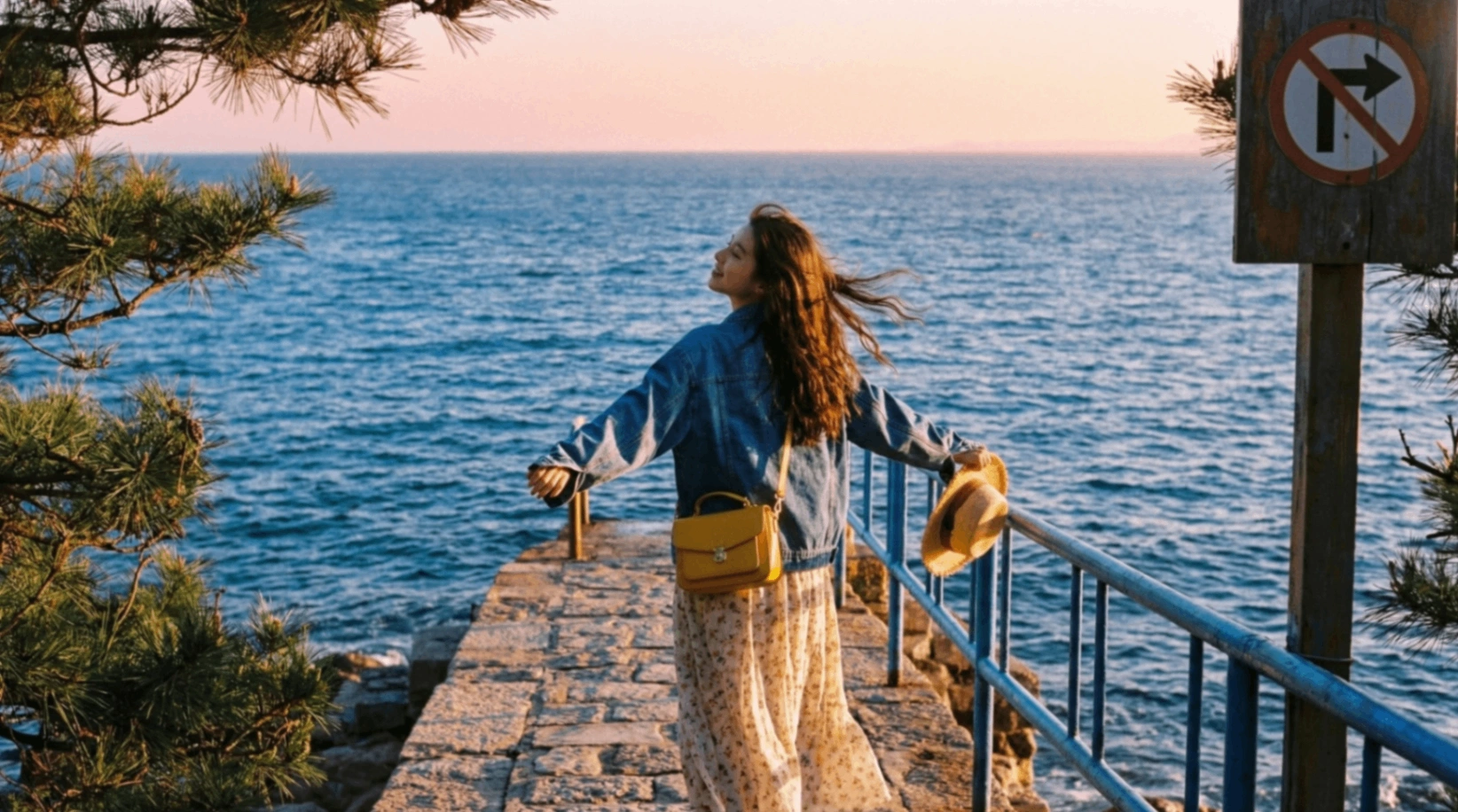
It started with something slightly off.
A friend sent me a batch of AI portraits the other day.
At first glance, they looked great. Soft lighting, clean composition, the kind of aesthetic you’d expect from a well-made template.
But the longer I looked, the stranger it felt. They didn’t really look like her.
Not in an obvious way. Nothing was broken. Nothing was “wrong.” Just… slightly unfamiliar. Like a version of her that had been gently adjusted to fit a style.
And I realized something I hadn’t paid attention to before:
Most AI portrait templates are very good at creating beautiful images. They’re less good at keeping you.
So I stopped browsing templates and tried building my own.
What I was trying to solve
The goal was simple:
Upload one half-body photo
Paste one prompt
Get a 3×3 AI portrait collage
Keep the same face, but tell a story across 9 frames
After some testing (using the same image reference every time), I ended up with:
🌸 Spring
☀️ Summer
🍁 Autumn
❄️ Winter
🌊 Aquarium theme
All built on the same structure, tested mainly with Nano Banana 2.
Spring — Soft, Airy, Almost Weightless
Spring was the easiest to get right.
It leans into everything AI already does well: soft light, pastel tones, gentle motion.
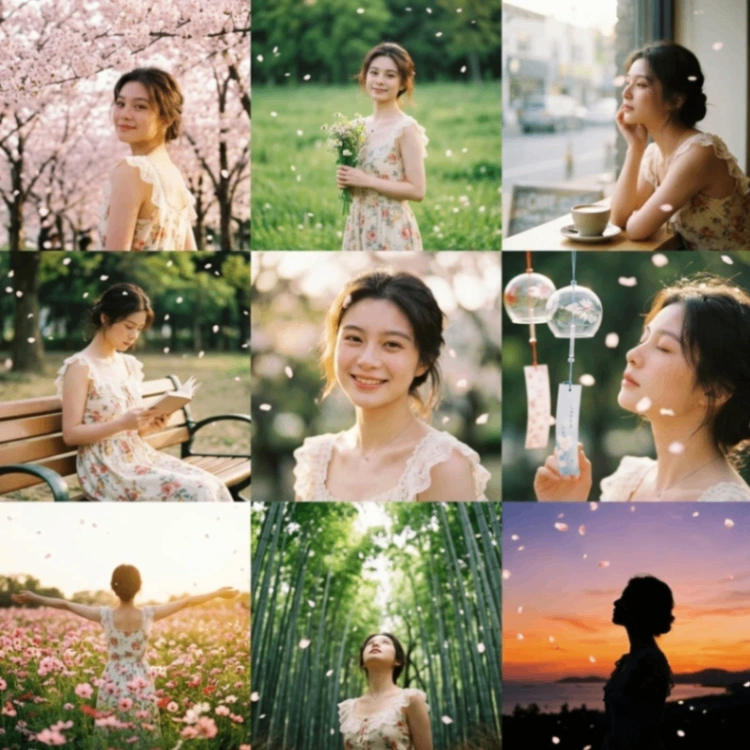
Prompt (copy & use):
a 3x3 grid collage of the portrait for a young woman in spring, divided into 9 continuous vertical segments showing her journey through a cherry blossom day: [1] looking back under pink trees, [2] holding flowers in green meadow, [3] gazing by café window, [4] reading on bench, [5] central portrait smiling to camera, [6] listening to wind chimes, [7] arms open in flower field back view, [8] looking up in bamboo forest, [9] silhouette against sunset.
Canon EOS R5, RF 50mm f/1.2L, 8K, continuous golden hour lighting, Fuji Pro 400H film tone, overexposed highlights, cyan shadows, pink-white skin tones, seamless transitions with floating petals, Japanese aesthetic, airy atmosphere
Summer — Nostalgia Hits Harder Than Expected
Summer turned into something else.
Less “pretty,” more emotional memory simulator.
Cicadas, train stations, fireworks — it’s all a bit cliché, but somehow it works.
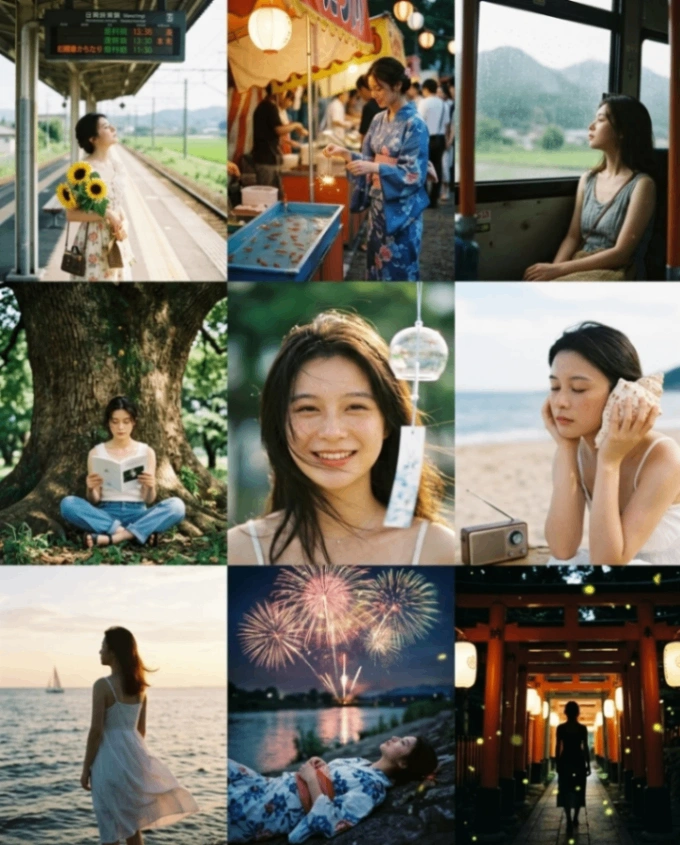
Prompt:
a 3x3 grid collage of the portrait for a young woman in summer, divided into 9 continuous vertical segments showing her journey through a nostalgic summer day: [1] standing at train platform with sunflowers, watching departure board, [2] holding sparkler at evening festival in yukata, goldfish scooping stall behind, [3] gazing from bus window, rain droplets on glass, blurred green mountains passing by, [4] reading graduation yearbook under big camphor tree, cicadas singing, [5] central portrait smiling to camera, wind chime and wind bell in background, [6] listening to sea waves with conch shell pressed to ear, beachside radio playing old J-pop, [7] arms open facing ocean at sunset, white dress fluttering, distant sailboat, [8] looking up at fireworks from riverbank, yukata obi loosened, reflection on water, [9] silhouette walking through torii gates at dusk, paper lantern lights beginning to glow.
Canon EOS R5, RF 50mm f/1.2L, 8K, harsh summer sunlight softening to golden hour, Fuji Pro 400H film tone pushed one stop, overexposed highlights +1EV, cyan-green shadows, amber skin tones glowing with heat, seamless transitions with drifting fireflies and wind chime sounds implied, Japanese summer aesthetic (natsukashii), humid air visible, sweat glow on skin, noisy cicada atmosphere
Autumn — Quiet, Slower, More Personal
Autumn felt… different.
Less about visuals, more about mood and texture.
Books, letters, vinyl — everything slows down.
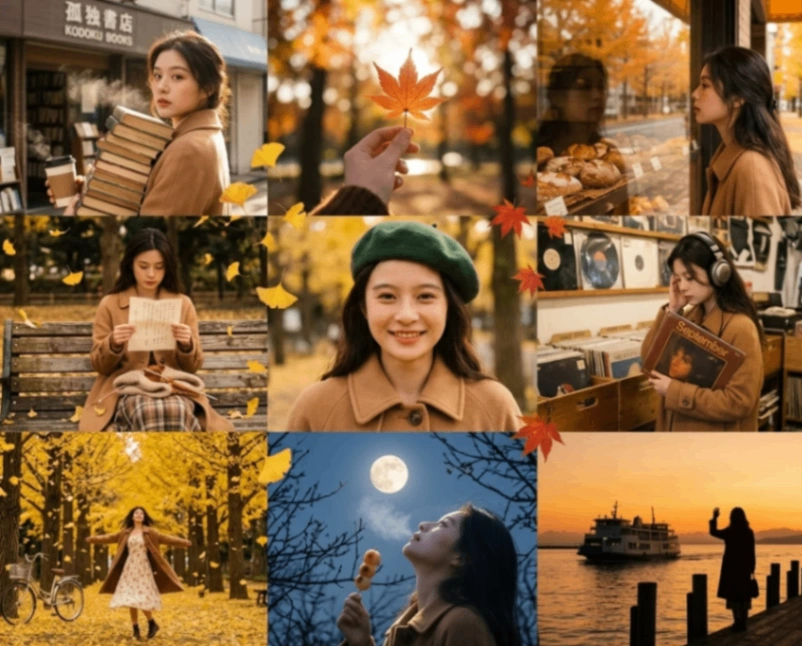
Prompt:
a 3x3 grid collage of the portrait for a young woman in autumn, divided into 9 continuous vertical segments showing her journey through a contemplative autumn day: [1] looking back at bookstore entrance, stack of used books in arms, steam from coffee cup, [2] holding fallen maple leaf against sunlight, examining vein patterns in park, [3] gazing by bakery window, fresh bread display, reflection of orange ginkgo street, [4] reading handwritten letter on park bench, scarf half-knitted beside , [5] central portrait smiling to camera, wearing camel coat, beret slightly tilted, [6] listening to vinyl record in used record shop, headphones on, album cover "September" visible, [7] arms open spinning in ginkgo tunnel, leaves falling like golden snow, vintage bicycle leaning nearby, [8] looking up at harvest moon through bare branches, holding dango skewer, [9] silhouette against sunset at old wooden pier, ferry boat departing, one hand raised in subtle farewell.
Canon EOS R5, RF 50mm f/1.2L, 8K, diffused autumn light filtering through colored leaves, Fuji Pro 400H film tone with warm push, overexposed highlights +0.3EV, deep amber shadows, cream-white skin tones with freckles, seamless transitions with falling ginkgo and maple leaves, Japanese autumn aesthetic (shūshin), crisp air visible in breath, wool texture and knit details, nostalgic solitude atmosphere
Winter — Contrast Carries Everything
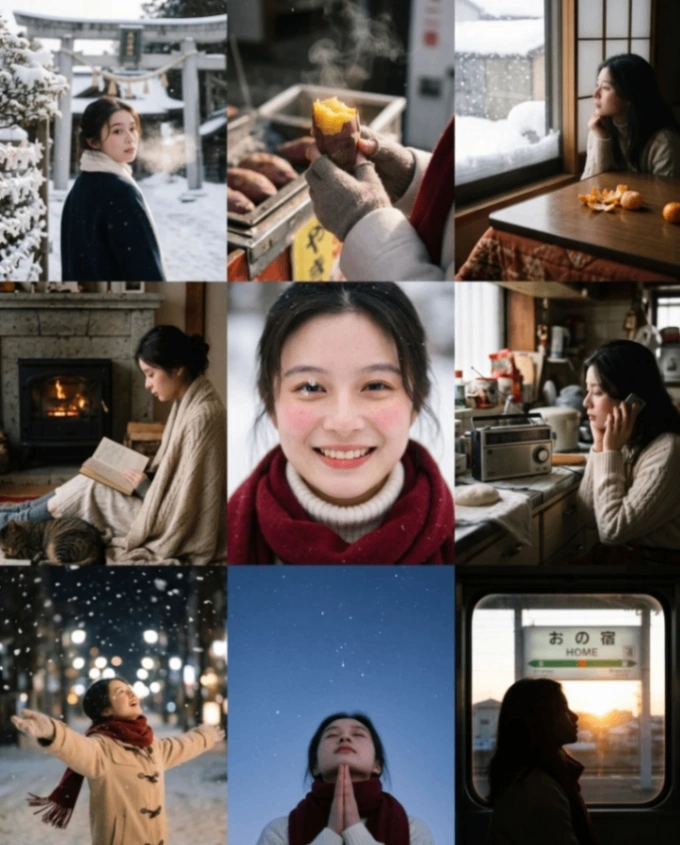
Winter works because of contrast.
Cold outside, warm inside. Blue vs orange. Silence vs small sounds.
It’s less “visual richness,” more emotional framing.
Prompt:
a 3x3 grid collage of the portrait for a young woman in winter, divided into 9 continuous vertical segments showing her journey through a tender winter day: [1] looking back at snowy shrine entrance, omikuji fortune tied to branch, breath visible in cold air, [2] holding hot sweet potato from street vendor, gloves with fingers exposed, steam rising, [3] gazing by kotatsu window, mandarin orange peels on table, snow accumulating on sill, [4] reading old diary by fireplace, blanket over shoulders, cat sleeping nearby, [5] central portrait smiling to camera, wearing white turtleneck and red scarf, snowflake on eyelash, [6] listening to grandmother's radio in kitchen, mochi pounding sound from neighborhood, [7] arms open catching snowflakes at night, street illuminations glowing behind, muffler flying, [8] looking up at Orion constellation, cold clear sky, wish made with closed eyes, [9] silhouette against sunrise from train window, New Year's first light hitting face, destination sign "Home".
Canon EOS R5, RF 50mm f/1.2L, 8K, soft winter light with long shadows, Fuji Pro 400H film tone pulled one stop, underexposed shadows -0.5EV preserving detail, blue-white highlights on snow, rose-cheek skin tones with natural flush, seamless transitions with falling snow and breath mist, Japanese winter aesthetic (fuyugomori), warm interior glow contrasting cold exterior, wool and knit textures, hopeful anticipation atmosphere
Aquarium — A Controlled Experiment
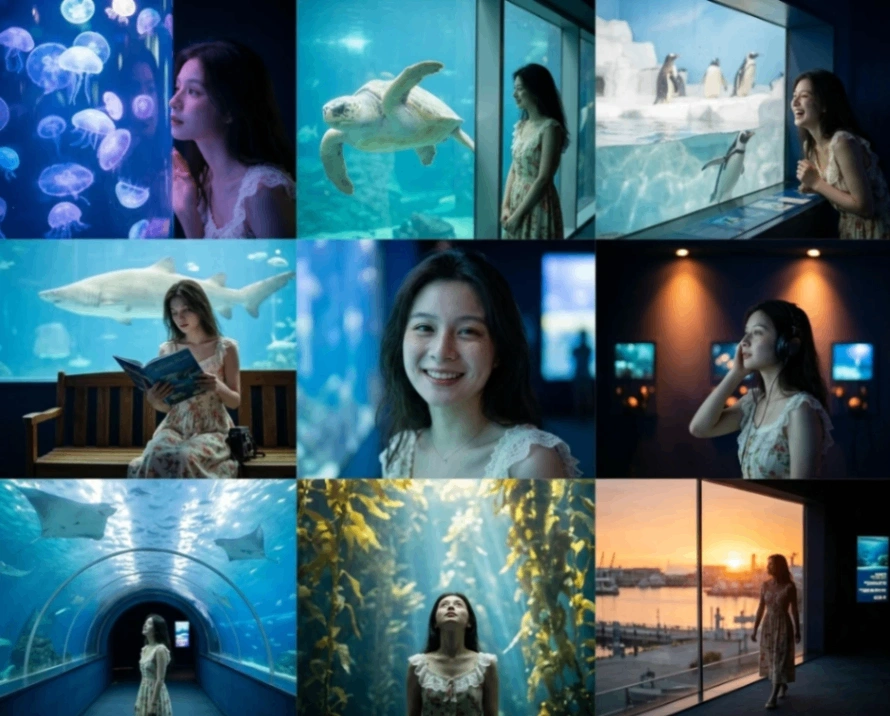
This one was more of a test.
Less seasonal, more about lighting and environment consistency.
Turns out: AI handles reflective surfaces better than expected.
Prompt:
a 3x3 grid collage portrait of a woman at an aquarium, nine connected scenes:
jellyfish tank, sea turtle glass, penguin window, reading bench, central portrait smiling, sound room with headphones, manta ray panorama, kelp forest looking up, exit at sunset.
Canon EOS R5, 50mm lens, 8K, blue and orange lighting, Fuji film tones, acrylic reflections, peaceful atmosphere
What actually makes this kind of prompt work
After running all five sets through the same image, a pattern became clear.
It’s not really about writing “better” prompts.
It’s about writing structured ones.
A simple way to think about it:
Lock the format
3×3 grid, always the same
Think in moments, not poses
Looking, holding, listening, waitingKeep one visual system
Camera, lens, color tone — don’t change them mid-wayAdd something that connects everything
Petals, snow, light, air — small details that move across frames
And maybe this is the real point
If the result doesn’t quite look like you, it’s usually not because the model failed.
It’s because the prompt is trying to make you look better, instead of letting you look specific.
That difference is easy to ignore at first.
But once you notice it, it becomes hard to go back.