Cargando...
Stofstopharts
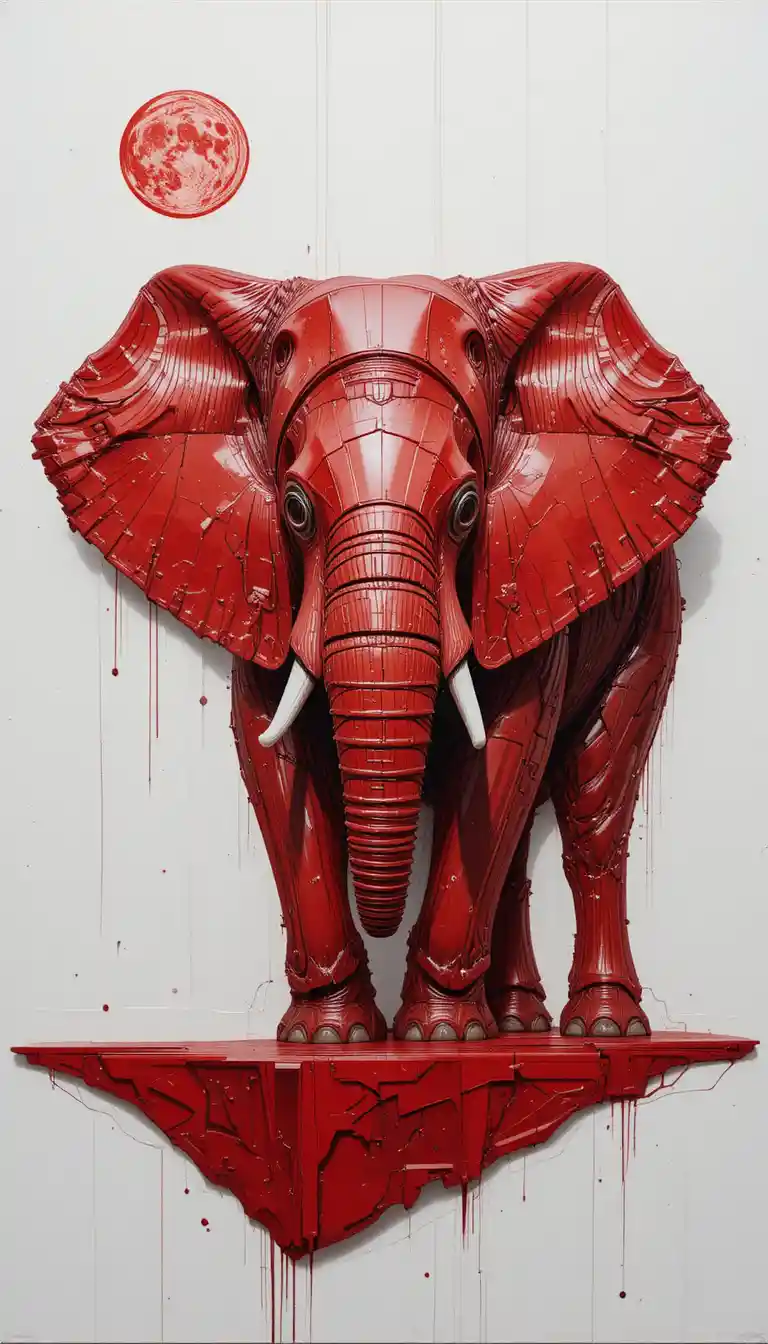
Elefante rojo abstracto emergiendo de audaz geometría en impasto
Prompt
An abstract elephant constructed from bold, angular slabs of cadmium red oil paint applied with a heavy palette knife. The composition is minimalist — the elephant emerges from geometric, intersecting planes of thick impasto against a stark white background. Each stroke is a distinct ridge of paint with sharp edges and glossy wet-looking highlights. The texture is so pronounced it appears three-dimensional, like frozen scarlet architecture. Contemporary art installation, dramatic studio lighting, high contrast, museum-quality photograph of the painting, ultra-sharp focus on the paint peaks.
, STYLE TRANSFORMATION LAYER:
The preceding prompt has absolute authority over the subject, identity, age, ethnicity, clothing category, setting, era, objects, action, and narrative. Preserve those elements exactly. Do not introduce recurring characters, white hair, robes, moons, temples, calligraphy, birds, flowers, fantasy armor, clockwork, or cultural motifs unless the base prompt requests them.
Transform only the visual language according to the following priority order:
1. CALLIGRAPHIC SILHOUETTE
2. EXPRESSIVE BROKEN LINE
3. RADICAL NEGATIVE SPACE
4. SELECTIVE ORNAMENT
5. UNCONTROLLED WATERMEDIA
6. PALE, UNCANNY FIGURE DESIGN
CALLIGRAPHIC SILHOUETTE:
Do not merely illustrate the subject accurately and decorate it afterward. Redesign its visible rhythm into one memorable, asymmetrical silhouette. Stretch hair, fabric, limbs, cables, foliage, smoke, machinery, weapons, or motion into elegant arcs, tapering diagonals, loops, spirals, and escaping strands. Let separate elements merge into a single sweeping compositional gesture. Preserve the subject’s function and identity, but allow its silhouette to become elongated, ornamental, improbable, and dreamlike.
For machines, vehicles, robots, armor, and technology, retain their recognizable category and purpose while transforming their construction into slender, skeletal, lacquered, jewel-like forms. Elongate frames, forks, limbs, barrels, chassis, supports, and cables. Replace bulky industrial masses with fine exposed mechanisms, bone-like structures, dark lacquer, delicate cords, irregular metal filigree, tiny articulated joints, and concentrated jewel nodes. Cables may behave like hair; panels may taper like feathers or blades; mechanical edges may dissolve into ink or unfinished paper. Avoid litera
Model
PicLumen Art V1
Date created
08/12/26 at 9:57 AM
Seed
4562432908
Guidance Scale
1
Resolution
768 x 1344 (9:16)
Related images