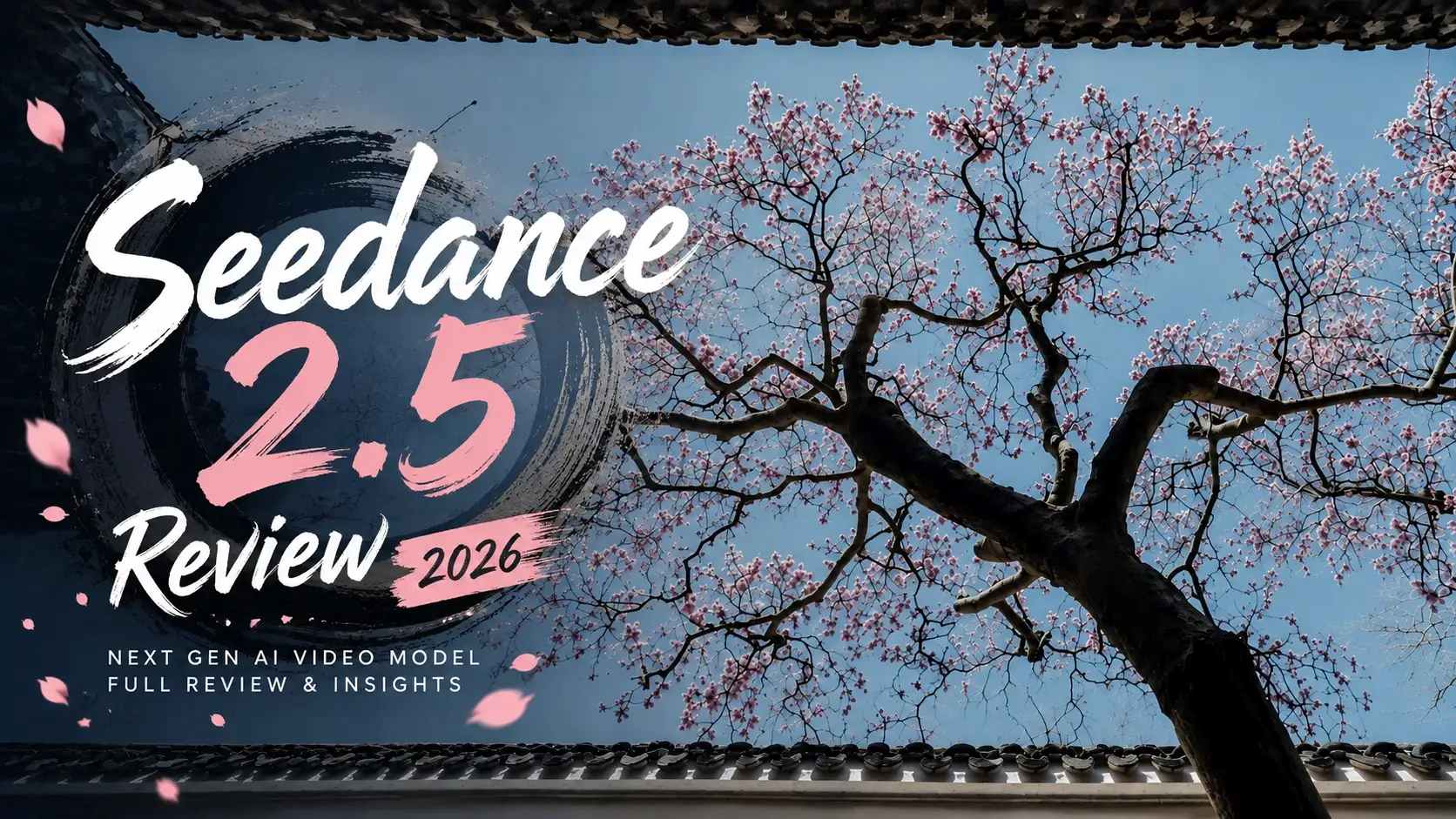
I've been testing AI video tools for a while, and I've learned to take big claims with a grain of salt. When ByteDance's Seed team announced Seedance 2.5, which is featured by 30-second single-pass generation, up to 30 images + 10 videos + 10 audio as references, and timestamp-level editing, it sounded like a checklist of everything creators keep asking for. I've seen great claims fall apart in practice before, so I decided to spend a day putting it through the kind of tests I'd actually care about: reference consistency, physical believability, and editing precision. The three short clips below are the ones I kept as evidence.
How I tested: I generated about 15 clips over the course of a day. I generated a mix of text-to-video and reference-based prompts, from simple single-shot scenes to multi-step timestamp plans. I kept 3 representative outputs for this review: one for reference consistency, one for physical believability, and one for 30s-video generation. And I judged them frame by frame, looking for the things that usually break.
TL;DR
Seedance 2.5 is the most controllable AI video model I've used this year. The 30-second single pass is actually impressive. And the multi-modal reference system is genuinely useful rather than a spec-sheet flex. For product videos, ads, brand content, and creator projects, I would highly recommend using this model.
What Is Seedance 2.5?
Seedance 2.5 is ByteDance Seed team's new-generation video model, built on the foundation of Seedance 2.0.
The headline feature is native 30-second generation. That matters more than it sounds: a 30-second scene gives room for setup, camera movement, subject action, and a clear ending. It also expands reference capacity up to 50, follows complex prompts more faithfully, and even supports multilingual creation.
Seedance 2.5 Specs at a Glance
Feature | Seedance 2.5 | Why It Matters |
Generation length | Up to 30 seconds (2.0: 15s) | Fuller scenes without constant stitching |
Image references | Up to 30 images | Maintains characters, products, style, scene details |
Video references | Up to 10 video clips | Guides camera movement, action, motion style, pacing |
Audio references | Up to 10 audio files | Guides rhythm, music mood, sound style, voice direction |
Multi-round extension | Yes, improved stability | Multi-minute videos without obvious drift |
Editing | Timestamp-level; green screen, camera perspective | Fix one detail without regenerating the whole scene |
Audio-video | Native joint generation, synced | No janky post-sync |
Seedance 2.5 Explained: What's Different This Time
Seedance 2.5's value is something you would instantly recognize after the first try. All the great upgrades and new features work together to make longer scenes easier to plan, direct, generate and polish.
30-second single-segment generation.
Doubling the single pass from 15 to 30 seconds changes what you can plan. Instead of one tiny action per clip, you get a mini-scene with setup, development, turning point, and resolution — the official demo follows a singer from the dressing room, through the backstage corridor, and onto the stage in one take. That's a story, not a clip.
Expanded multimodal reference input.
Up to 30 images, 10 video clips, and 10 audio clips in a single pass, with specialized modes for motion, and creative references. For anyone who storyboards or works with brand assets, this is where the control actually lives.
Timestamp-level editing.
You can control narrative, camera, and rhythm per time frame during generation — "0–5s: close-up, 6–10s: circle, 11–20s: pull back" — and make targeted edits after generation without nuking the whole render. Green screen and camera-perspective editing is also a great feature that means a great deal for marketers and film makers.
Visual quality that looks less "AI."
The model adds native 4K output and it systematically cleans up object textures, skin and eyes, lighting, and color saturation. Output starts to approach live-action quality.
The Stress Tests: Three Things I Actually Care About
I skipped the obvious demo scenarios and tested the things that bite me in real projects: reference consistency, physical believability, and editing precision. Each test is an 8-second clip — short enough to load fast, long enough to reveal the model's character.
Test 1: Multimodal Reference — Many Pictures, One Prompt
For the first test, I went after the feature Seedance 2.5 is actually advertising: multimodal reference. I uploaded six character reference images — a cashier, an office worker, a young woman, two middle-aged women, and a woman on a night jog — plus a scene reference, and asked for one 10-second convenience store scene in a single take.
Prompt: 10-second convenience store scene at night, 16:9, cinematic realism, warm interior lighting, single continuous take, smooth gimbal camera movement, no cuts. Character references: @Image 1 (cashier), @Image 2 (office worker), @Image 3 (young woman), @Image 4 (middle-aged woman A), @Image 5 (middle-aged woman B), @Image 6 (jogging woman). Scene reference: @Image 7 for the store interior.
0–3s: High-angle wide establishing shot matching @Image 7, camera slowly pushing in. The cashier stands behind the counter, the office worker pays at the counter, and middle-aged woman A browses the shelves in the background.
3–6s: The camera pans right along the aisle. The jogging woman enters through the door on the right, walks to the drink fridge, and grabs a bottle of water. The young woman picks up a snack from the shelf. Middle-aged woman B pushes her shopping basket past the camera.
6–10s: The camera arcs back toward the counter and pulls back to a wide shot. The jogging woman brings her water to the counter to pay, the young woman walks over with her snack, the office worker stands beside the counter, middle-aged woman A walks up from the shelves, and middle-aged woman B arrives with her basket.
The good news: all six characters showed up, and they strictly followed their reference images. Even the group shot at the end kept all six distinguishable. For a model juggling multiple character references in one pass, that's genuinely impressive.
Then there are some minor issues. When the jogging woman pushed the door open, the swing was just wrong. It's like it was hinged on nothing and slid sideways. Also, on the first few generations, characters kept flashing between positions: one second at the fridge, the next at the counter, with no transition in between. But this problem is solved by adjusting camera movement and character motion.
Test 2: Physical Believability — Product Visual
For the second test, I made a 10-second product promo for a fictional PicLumen soda. The scene is about a young girl in a school corridor, a row of lockers, and a pink soda can as the hero. I went in with a suspicious mindset, because condensation, fizz, liquid physics, and a logo that has to stay sharp are exactly where AI video usually falls apart.
Prompt: 10-second PicLumen soda commercial, 16:9, cinematic editorial style, high contrast, cool school-corridor palette with warm product accents, playful dynamic camera work, fast rhythm. Character references: @Image 2. Scene reference: @Image 1. Product reference: @Image 3
0–2s: Quick push-in on a locker door; the girl swings it open and grabs the PicLumen can standing inside on the shelf, condensation droplets visible on the surface.
2–4s: She tosses the can up into the air, spins around, and catches it behind her back; the camera whips to follow the can's arc.
4–7s: Slow motion: she pops the tab — fizz bursts, droplets float in the air — then takes a sip; her hair and skirt drift naturally; the camera orbits around her.
7–10s: She lowers the can, walks a couple of steps toward the camera along the corridor, stops, and holds the can up with the logo facing the lens; the camera pulls back slightly and holds the final frame. Crisp sound design: locker clang, fizz, echoing footsteps
Honestly? The outcome was impressive. The lighting obeyed physical rules. The direction, color temperature, shadows all made sense. And the details like reflections stayed consistent rather than glitching every few frames. The character motion was natural. That's a real improvement over the glossy, uncanny output I'm used to.
Test 3: Long-Form Storytelling — One Take, One Complete Story
For the third test, I went after the headline feature: 30-second single-pass generation. I asked for a 30-second single continuous handheld shot following a girl from a reference image through a summer party in a Parisian house.
Prompt: SEQUENCE SHOT. NO CUT. Single continuous unedited handheld shot, 30 seconds total, shot with a real handheld camera, natural imperfections, documentary realism. Character reference: @Image 1
The girl from @Image 1 sits on a sofa inside a bright, spacious suburban Parisian house. Summer afternoon sunlight streams through large windows. Young adults dance, laugh, and hold drinks around her; music and chatter audible in the ambient room sound.
[0-5s] Camera behind and slightly to the right of the sofa, shoulder height. She stands up and walks toward a kitchen table in the background; the operator follows at a natural distance, footsteps audible on the wooden floor.
[5-10s] At the table, she pours champagne from an already-open bottle into a glass and takes a small sip. The camera pushes in over her shoulder; her movements are natural, not exaggerated.
[10-18s] She sets the glass down, walks through standing guests toward a large bay window (framing briefly lost as a guest passes, then regained), stops, and looks out at the garden. The camera steps to her left for a three-quarter side view as she tucks a strand of hair behind her ear.
[18-22s] She pushes open the glass door and steps into the garden — exposure briefly overexposes, then settles; footsteps shift from wood to stone — and stops at the pool edge, where a friend sits with her legs in the water and gestures up at her.
[22-26s] The friend playfully splashes water toward her, the arc catching sunlight; she laughs, steps back, blocks with her hand, wipes a droplet from her cheek, and swishes her foot back at the friend, who splashes again. The camera holds the two-shot.
[26-30s] She sets her glass on a small table, returns to the pool edge with her hands on her hips, smiling; the camera ascends from chest height to a wide aerial view — revealing the garden, the pool with swimmers, and the large Parisian house in warm late-afternoon light.
The result was excellent. The camera movement came out smooth, the transitions between spaces felt natural, and the whole shot held together as one continuous, believable take. The character stayed consistent with her reference image the entire time, and the little human details landed pretty well. For a single 30-second pass, that's the best long-form result I've seen from a video model.
Try Seedance 2.5 on PicLumen!What Impressed Me After Testing
Seedance 2.5 impressed me because the upgrades feel practical. They hit the pain point of AI video generation:
30-second scene creation: I can plan a complete mini-scene with setup, motion, reveal, and ending instead of forcing one tiny action into a short clip.
Reference control that works well: Product shape, character identity, scene design, motion style are all easier to guide with references than with text alone, and it actually holds.
Less "AI look": Textures, skin, lighting, and reflections are believable enough that I don't feel the need to do much post-editing.
Use Case: Who should Actually Use It?
Use Case | Why Seedance 2.5 Works Well |
Short drama scenes | 30s gives room for setup, acting, camera movement, emotional payoff |
Product videos | Large reference capacity preserves product shape, texture, color, lighting |
Story ads | Timestamp prompts + longer scenes support hook, demonstration, reveal in one clip |
Social reels | Smoother motion and cinematic quality suit polished creator content |
Music & performance content | One-take generation with native audio-video sync |
Video continuation | Extension stability builds longer scenes from a strong starting shot |
Brand videos | Consistent references guide visual identity across people, products, scenes |
Education & training | Turns abstract concepts into vivid, structured visuals |
Concept previews | 30-second outputs make storyboards and campaign ideas easier to evaluate |
Where to Try Seedance 2.5?
If you'd like to test Seedance 2.5 as well, PicLumen is a solid option. PicLumen is an AI image and video creation platform that brings multiple generation models into one place. Instead of jumping between tools, you can go from text prompt to reference image to finished video in a single workspace.
Final Thoughts
Seedance 2.5 is one of the most exciting creative releases this year. It moves video generation from impressive short-clip output toward longer, more controllable, more production-ready creation.
I'd recommend using it for short dramas, product videos, story ads, brand visuals, music-content projects, and reference-heavy briefs. The model feels especially valuable when you need a scene with structure.
FAQs
What is the biggest Seedance 2.5 upgrade?
Native 30-second generation. It changes the workflow because you can build a fuller scene with setup, action, camera movement, and ending.
What reference materials does Seedance 2.5 support?
Up to 30 images, 10 video clips, and 10 audio clips in a single pass, plus specialized modes: clay render, motion, and creative references.
Can Seedance 2.5 edit existing videos?
Yes — timestamp-level targeted edits, green screen editing, camera perspective editing, and reference-based editing, both during and after generation.
Where can I use Seedance 2.5?
Seedance 2.5 is available on PicLumen right now. You can start creating 30-second video with up to 50-references right away.
What's the maximum clip length on Seedance 2.5?
Up to 30 seconds in a single pass — and if you need more, multi-round extension lets you keep appending clips until you have a multi-minute video.